No, But Why? - Multi-Vendor OSPF Lab with Containerlab (VyOS + FRR)
Build a real multi-vendor OSPF lab with Containerlab: two VyOS routers and two FRR routers in a redundant square, one OSPF area, plus a link-failure demo.
Published: Sunday, October 11th, 2026
Description
This tutorial builds a working multi-vendor OSPF network in about fifteen minutes: two VyOS routers and two FRRouting routers wired in a redundant square, running a single OSPF area, with two Linux hosts passing traffic across it. Along the way we'll hit a real cross-vendor bug (an MTU mismatch that wedges OSPF in ExStart), diagnose it, fix it, and then deliberately break a core link to watch OSPF reroute around the damage.
Summary and Agenda
Why Containerlab, Why These Two Vendors
Prerequisites
The Topology
The Files: Topology and Router Configs
Deploying the Lab
Verifying OSPF Convergence
War Story: The MTU Bug
Failure Demo: Cutting a Core Link
Cleaning Up
Why Containerlab, Why These Two Vendors
A few years back I wrote a tutorial that converged three Cisco routers with OSPF inside GNS3 (it's still here). It works, but it asks a lot of the reader: install GNS3, find a Cisco IOS image (good luck with the licensing), and learn a GUI. This tutorial is its spiritual successor with the friction removed.
Containerlab turns network topologies into a single YAML file. Each node is a container, links are virtual cables, and containerlab deploy builds the whole thing. No GUI, no image hunting for the routing software itself.
The vendors are the interesting part. VyOS is a real, open-source network OS with a Junos-style CLI — the same configuration hierarchy and operational commands you'd meet on Juniper gear. FRRouting (FRR) is the open-source routing suite that powers a remarkable amount of real infrastructure, speaking fluent Cisco-isms through vtysh. Running OSPF between them proves the point that matters: OSPF is OSPF. The protocol doesn't care whose logo is on the box, and this lab makes you believe it because you'll watch the two CLIs agree with each other.
Prerequisites
You need a Linux machine (bare metal or a VM — nested virtualization works, but give it real cores) with:
Docker — any recent version.
KVM — /dev/kvm must exist. The VyOS nodes are full virtual machines in containers; without hardware virtualization they won't boot.
Containerlab — one line:
$ bash -c "$(curl -sL https://get.containerlab.dev)"
$ containerlab version
Two container images:
FRR — quay.io/frrouting/frr:10.7.1. Note the registry: the frrouting/frr repository on Docker Hub is stale (v8.x at last check). The project's official images live on Quay.
VyOS — there is no official VyOS container image, so we build one from the free 1.5-stream ISO. Download the ISO from vyos.io, then:
That needs squashfs-tools-ng and libarchive-tools on the build host. The Dockerfile is three meaningful lines — unpack the root filesystem onto scratch, mask a couple of services that make no sense in a container, and boot systemd:
FROM scratch
ADD rootfs.tar /
RUN for service in getty.target auditd.service; do systemctl mask $service; done
HEALTHCHECK --start-period=10s CMD systemctl is-system-running
CMD ["/sbin/init"]
The Topology
Four routers in a square. VyOS on the edges, FRR in the core, one Linux host hanging off each VyOS node:
Every router-to-router link is a /30, every router has a /32 loopback that doubles as its OSPF router-id, and everything lives in OSPF area 0:
The square is deliberate: every router has two disjoint paths to every other router. That redundancy is what the failure demo at the end will exercise.
The Files: Topology and Router Configs
Everything lives in one directory. The topology file wires the nodes, pins the MTU on every link (more on that later), and hands each router its config:
# vyos-frr-ospf.clab.yml
name: vyos-frr-ospf

topology:
  kinds:
    vyosnetworks_vyos:
      image: vyos-local:1.5-stream-2025-Q2
  nodes:
    vyos-1:
      kind: vyosnetworks_vyos
      startup-config: configs/vyos-1.boot
    vyos-2:
      kind: vyosnetworks_vyos
      startup-config: configs/vyos-2.boot
    frr-1:
      kind: linux
      image: quay.io/frrouting/frr:10.7.1
      binds:
        - configs/frr-1/daemons:/etc/frr/daemons
        - configs/frr-1/frr.conf:/etc/frr/frr.conf
    frr-2:
      kind: linux
      image: quay.io/frrouting/frr:10.7.1
      binds:
        - configs/frr-2/daemons:/etc/frr/daemons
        - configs/frr-2/frr.conf:/etc/frr/frr.conf
    host-1:
      kind: linux
      image: nicolaka/netshoot:latest
      exec:
        - ip addr add 192.168.10.10/24 dev eth1
        - ip route replace default via 192.168.10.1
    host-2:
      kind: linux
      image: nicolaka/netshoot:latest
      exec:
        - ip addr add 192.168.20.10/24 dev eth1
        - ip route replace default via 192.168.20.1
  links:
    - endpoints: ["vyos-1:eth1", "frr-1:eth1"]
      mtu: 1500
    - endpoints: ["frr-1:eth2", "frr-2:eth1"]
      mtu: 1500
    - endpoints: ["frr-2:eth2", "vyos-2:eth1"]
      mtu: 1500
    - endpoints: ["vyos-2:eth2", "vyos-1:eth2"]
      mtu: 1500
    - endpoints: ["vyos-1:eth3", "host-1:eth1"]
      mtu: 1500
    - endpoints: ["vyos-2:eth3", "host-2:eth1"]
      mtu: 1500
FRR configures OSPF the way you'd expect if you've touched Cisco gear — interface addresses plus ip ospf area 0, and a router-id. Here's configs/frr-1/frr.conf in full (frr-2 is the mirror image: eth1 10.0.23.2/30 toward frr-1, eth2 10.0.34.1/30 toward vyos-2, router-id 10.255.0.4):
frr version 10.7.1
frr defaults traditional
hostname frr-1
!
interface eth1
 description to vyos-1
 ip address 10.0.12.2/30
 ip ospf area 0
!
interface eth2
 description to frr-2
 ip address 10.0.23.1/30
 ip ospf area 0
!
interface lo
 ip address 10.255.0.3/32
 ip ospf area 0
!
router ospf
 ospf router-id 10.255.0.3
!
Alongside it, configs/frr-1/daemons enables the daemons we need (zebra=yes, ospfd=yes, staticd=yes, everything else no).
VyOS does the same thing in its own idiom — a configuration hierarchy instead of per-interface commands. Here's the interesting part of configs/vyos-1.boot (vyos-2 mirrors it with .2 addresses; the file also carries the admin user and a vyos-config-version footer, both copied from a generated default config):
Containerlab pulls the images, creates six containers, and wires the virtual cables. Then wait: the VyOS nodes take two to three minutes to reach healthy on first boot. They're full VMs initializing a real OS, not lightweight processes. FRR and the hosts are up in seconds. sudo containerlab inspect -t vyos-frr-ospf.clab.yml shows the table; you're ready when both VyOS nodes report (healthy).
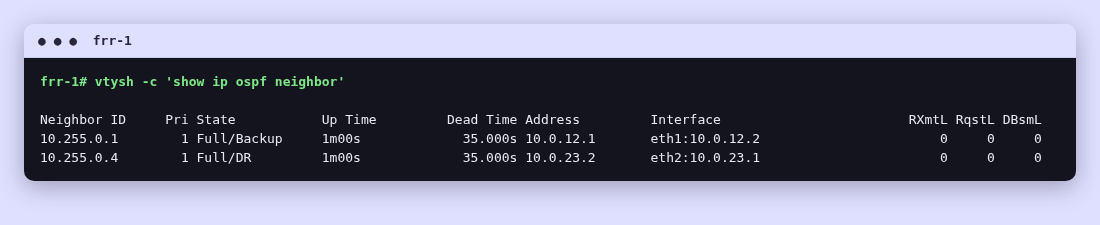
First, the FRR side. show ip ospf neighbor should show both adjacencies Full — one toward vyos-1, one toward frr-2:
Figure 01 - OSPF neighbors on frr-1: all adjacencies Full
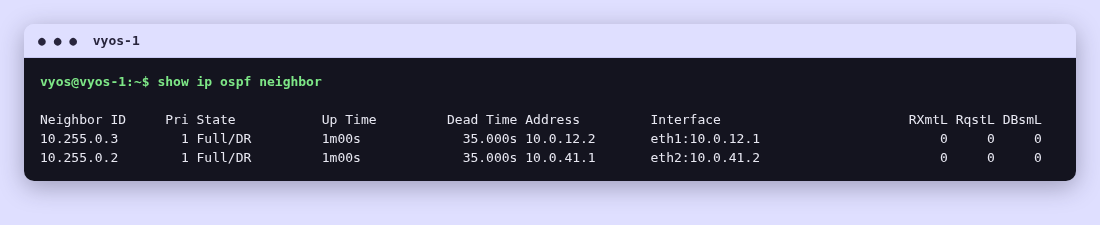
Now the same question in VyOS's dialect. The command is identical — show ip ospf neighbor — but you're asking a different operating system:
Figure 02 - The same neighbors from the VyOS side
Two vendors, same protocol, same answer. The loopbacks (10.255.0.1–.4) are the router-ids, so you can read straight off which neighbor is which.
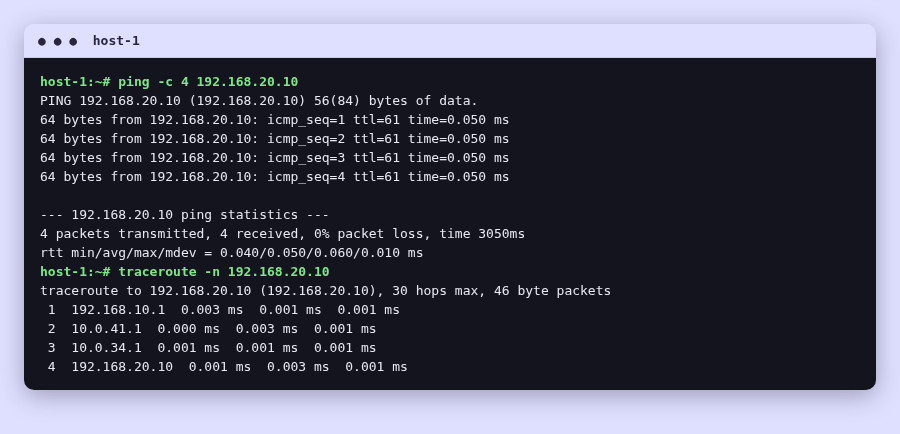
End to end: from host-1, ping host-2 across the square:
Figure 03 - End-to-end: host-1 reaches host-2 across the square
Four replies, zero loss. The converged network works.
War Story: The MTU Bug
This is the part of the tutorial I'm proudest of, because it really happened while building this lab — and it's the kind of bug that eats an afternoon if you've never seen it.
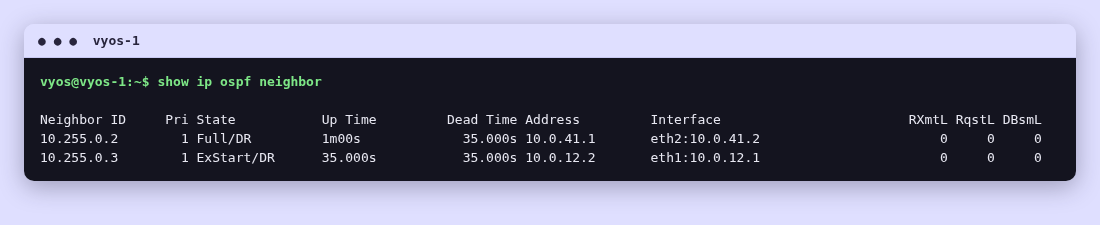
The first deploy brought up the same-vendor links just fine. But the two cross-vendor links — vyos-1↔frr-1 and vyos-2↔frr-2 — would not form adjacencies. On the VyOS side, the neighbor sat there like this:
Figure 04 - The MTU bug, live: vyos-1 sees frr-1 stuck in ExStart
ExStart, forever, while the other neighbor sat at Full. If you've run OSPF for a while, that state has a smell: the two routers are stuck exchanging database description packets and never getting anywhere. The usual suspects are MTU mismatch, duplicate router-ids, or an ACL eating unicast. Router-ids were unique. No ACLs in a lab. So: MTU.
$ sudo docker exec clab-vyos-frr-ospf-frr-1 ip link show eth1 | grep -o 'mtu [0-9]*'
mtu 9500
There it is. The FRR container image brings its data interfaces up at MTU 9500; VyOS uses 1500. During the DBD exchange, FRR advertises a larger MTU than VyOS's interface can handle, and per RFC 2328 the neighbor drops back to ExStart — on every attempt, forever. The same-vendor links were fine because both ends agreed with each other; only the mixed links broke, which is exactly why it looked so confusing at first.
The fix is the one line per link I flagged in the topology file:
Containerlab sets the MTU on the virtual cable itself, so both ends inherit it. With that pin in place, all eight adjacencies go Full. In production you'd fix this with ip ospf mtu-ignore or by standardizing MTU — in a lab, pinning it in the topology is the honest fix, and now the topology file documents the requirement.
Failure Demo: Cutting a Core Link
The square earns its keep now. Kill the frr-1↔frr-2 link from inside the frr-1 container:
$ sudo docker exec clab-vyos-frr-ospf-frr-1 ip link set eth2 down
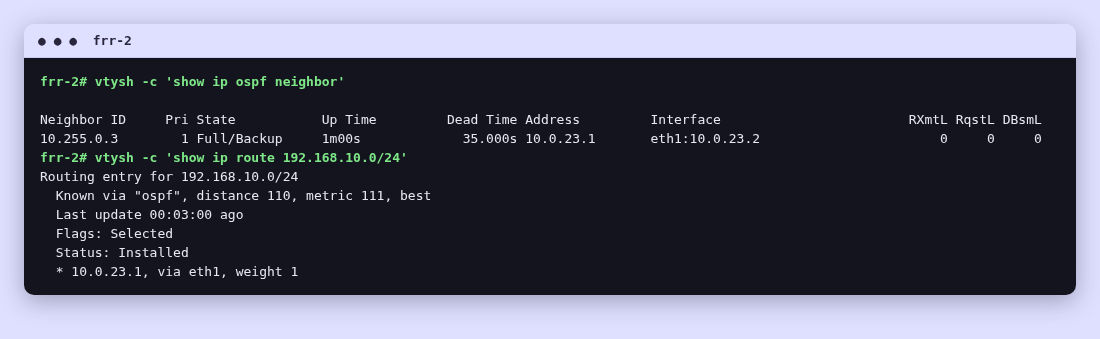
OSPF notices within seconds — the interface going down is an immediate event, no waiting on dead timers. frr-1 drops to a single neighbor, and its route to frr-2's loopback (10.255.0.4) reroutes the long way around the square, via vyos-1:
Figure 05 - frr-1 to frr-2 link down: one neighbor left, frr-2's loopback reroutes the long way around
Meanwhile, keep a ping running from host-1 to host-2 through the whole thing: zero packet loss. The host-to-host path (vyos-1 → vyos-2 direct) never touched the broken link, and OSPF rerouted everything else around it before you'd notice.
Bring the link back:
$ sudo docker exec clab-vyos-frr-ospf-frr-1 ip link set eth2 up
The adjacency reforms and returns to Full in about forty seconds on default OSPF timers, and the route to 10.255.0.4 flips back to the direct path. That's the whole point of the square: no single link failure should matter, and now you've watched it not matter.
Everything — containers, virtual cables, the lot — is gone. The lab is a YAML file and four configs; redeploying takes one command whenever you want it back.
What I'd suggest next: change something. Add a fifth router. Break the square into a triangle and re-run the failure demo. Move one link into OSPF area 1 and watch what changes. The lab is cheap to rebuild, so the cost of curiosity is about three minutes.